text
test
Categories
Making Sense of the World
What do ‘Innovation, philosophy, and Christianity‘ have in common? They are the lens through which I try to make sense of the world. ‘Making sense of the world’, is what I usually tell people when they ask me what I do.
Terms such as innovation, design, and philosophy make sense to me because of my personality and history. In projects and jobs that I really enjoyed, there was always an element of exploration, strategy, reflection, and creativity. The common denominator is something like ‘sensemaking.’ Throughout my life, I keep coming back to this desire, need, and calling to understand the world and to find my place in it.
Philosophy
I came to philosophy through hermeneutics. Hermeneutics is the art and science of the interpretation of signs. More specifically, it deals with how to read a text and how to do that well. This is a crucial skill in a multicultural and multilingual world. But as a philosopher, I also want to think about the process behind the practice, understand how it works, and how we can think better about it. This is why I got involved in Translation Studies as a kind of ‘applied hermeneutical practise’.
Sensemaking
Hermeneutics is a good example of philosophy as sensemaking. One of the key insights of twentieth-century hermeneutics is that sense is both made and found. Whether we read a text or engage with the world around us, we are always moving between something which is given to us and the emerging interpretation of it in us. We look at the parts to make sense of the whole. At the same time, we come with a sense of the whole (a pre-judgement), through which we interpret the parts. This combined sense-making and sense-discovery takes place in a cycle of back-and-forth between parts and wholes, between initial sense and unfolding insight. It is the basic structure of how we engage with the world around us. This happens all the time, not just when we read a text, but also when we ‘read the room’ during a meeting or when we navigate rush hour traffic.
Design Thinking as sensemaking
My first serious engagement with Design Thinking was a couple of years ago, when I participated in an incubator led by the innovation team of the Protestant Church in the Netherlands. In the process, I developed a prototype of a School for Cultural Literacy. In the workshop, participants engage in a meaningful conversation with ‘Big Questions’ through reading and reflection on some significant texts (from Plato to Wendell Berry). Design Thinking helped me to reframe a philosophical practice into an engaging group activity. I also discovered that I love tinkering with things, artefacts, and prototypes as a way of making sense of thoughts in material form.
Design as practical/speculative philosophy
Design Thinking emerged in the worlds of engineering and business. This seems far removed from the philosophical questions about meaning. Yet, I see Design practitioners explicitly engage with ethical dilemmas, like John V Willshire, who would rather ‘Make Things People Want’ than ‘Make People Want Things’. This places Design Thinking in an ethical perspective, reframing it as regenerative engagement with the world. A lot of work on (Speculative) Futures and foresight seems to move in a similar terrain. What intrigues me is how the speculative aspects of Design Thinking touch the practical philosophy of sensemaking.
Making sense of the world is challenging. One of the persistent struggles of modern and post-modern philosophy is overcoming dualisms, such as ‘form vs content’. For me, both the philosophical practice of hermeneutics and design thinking/speculative futures research are modes of engaging in that project.
Sensemaking and theology
Sensemaking also has to do with metaphysics, which deals with the most basic questions about the nature of reality. Some of these questions also touch on matters of faith and religious experience. This makes sense because for most of the history of Western philosophy, two streams have contributed to this field: classical Greek thought and Christian theology.
Is this still relevant? I think so. For generations, we have been told that we live in a material world. This approach has brought us ‘progress and prosperity,’ but at a great cost. Some people notice the cracks in the ‘immanent frame,’ while others are considering alternative metaphysics. Regardless of our personal position on this, it seems clear that the way we frame the world has a major impact on how we make sense of the world and our place in it. This is one of the points where philosophy bleeds into theology (or vice versa), and that makes sense to me.
As a theologian, I am interested in connections with other disciplines, both with academic philosophy (hermeneutics) and with Design Thinking as practical philosophy. Design Thinking is a practical tool, for example, for thinking about the impact and valorisation of our research. It can help with practical questions like how we form connections or how we relate to the soil on which we live.
For me, this is also an existential point of connection. The creation story in Genesis shows a Creator-Spirit who designs/creates something fragile, yet of incredible beauty. What if reflecting that Image has something to do with becoming fully alive? That makes a lot of sense.
(1st draft of a longer essay, feedback is welcome!)
Categories
How to Think About (Big) Things
Faith and Culture. The Future of Christianity. Europe. These are some of the big things I write about here. The challenge is that these ‘things’ are so big and complex that we cannot treat them like simple yes-or-no questions. So, how do we think about big things?
This is one way of looking at it:
Last month I organised a workshop with my colleagues at the Knowledge Centre for Theology at the Protestant Theological University in Utrecht, NL. In the morning session, we looked at who we are. Inspired in part by John Willshire’s recent reflections on “things” and Zenko Mapping (see here), I presented a social/material matrix for things. No worries if that does not ring a bell, I’ll explain how it works.
The matrix simply maps who we work with (social) against what we produce (material). For example, organising a lecture is both a social activity (working with speakers and audiences) and a material one (producing a tangible event).
A Knowledge Centre is a thing with a social dimension. We are, first of all, a team of four colleagues. As a team, we are tasked with advancing the impact agenda of our (small) university. We therefore work with researchers, lecturers, the board, and various project groups. As a university, we also collaborate with many partners, such as other theological universities, churches, professional bodies, and publishers. Finally, there is a wider network that extends well beyond the university.
As the Knowledge Centre, we are also a thing with a material dimension. We create tangible outputs. These include books, lectures, events, and podcasts. One distinct category is our continuing education offering, with its own structure and workflow. We also provide services. We help colleagues translate their knowledge and expertise into formats that can be shared beyond the university. We advise, brainstorm, and co-create with them. One specific type of service is policy development, usually for the university’s leadership team.
Combining these two dimensions led us to the Social/Material Matrix — a tool for thinking about organisational activities. This helped us see where our energy really goes — and where it doesn’t.
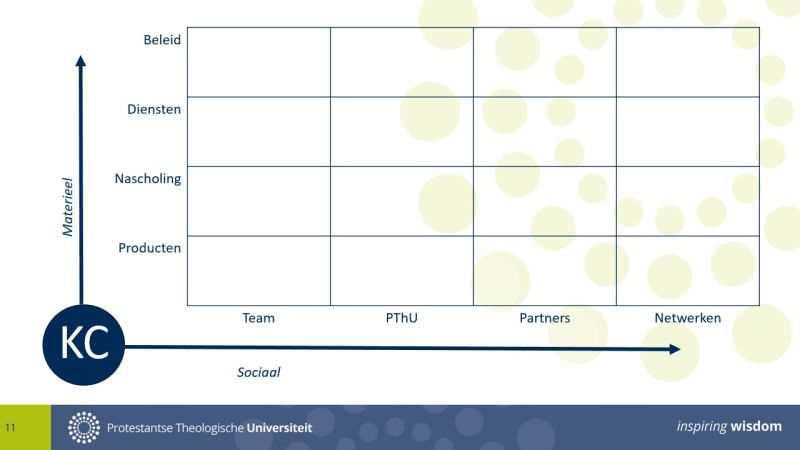
As a team, we used this matrix to map some of our regular activities. After 20 minutes, we had covered most fields with post-its. Of course, there were questions: why are some fields so crowded? Is it okay that we don’t do a lot of X for group Y? Who is most active in which category? The matrix is a good basis for a team heatmap and a starting point for further questions.
Another way to use the matrix is for a life-cycle analysis of projects. This proved helpful in the case of a project in which we first created a publication and then a course. Plotting the transition from one phase of the project to the next made clear where our friction points were. This will help us when planning future projects.
Background
While I was preparing the workshop, my mind went back to a book called “What is a Thing?”. This book is not about ‘objects’, but rather about the question what does it mean for something to be a ‘thing’ at all? The author, Heidegger, argues that a thing is never just a measurable object, but always more than what our modern thinking tells us.
A thing is not just a material resource, a tool or a product. It only becomes meaningful in a world of relationships. For example a book: of course is consists of paper, ink and glue. But is is more then that: it is also knowledge, culture, meaning and a dialogue. The thing ‘gathers’ a world, it ‘reveals’ meaning to us.
A book exists in a web of relationships. This also means that the thing itself changes as its relationships change. A book could be: something for sale in a bookshop, something the reader rembers years later, a useful object in church, an artifact in a museum. The ‘thingness’ changes with the world around it. If we reduce things to measurable objects, they lose meaning, we lose meaning, and the world becomes poorer and flatter.
A philosophical question to ask about things is how they appear as meaningful to us. This question makes sense intuitively, even if answering it is not easy at all. The flipside of this idea is that things are also like a mirror to us. The way we treat things reveals something about how we relate to the world. For example:
- Do we treat the natural world as a resource to extract value from? It shows.
- Do we treat a Church as the place where we meet God? Our behaviour shows it.
- Do we look at ‘the future’ because we are anxious about the present, or disconnected from our past? It will be visible in the way we think and talk about the future.
With that last example, we have made the connection with the ‘things’ we think about here. How can we think about faith and the future of Europe as meaningful ‘things’? What would be relevant questions to explore? (Regardless of whether we draw a matrix for it or not.) I don’t know, but I am interested in hearing your thoughts.